Short answer: Perplexity SEO starts with access: allow PerplexityBot in robots.txt and let its published IP ranges through your firewall, because PerplexityBot is the crawler Perplexity uses to surface and link websites in its search results. Perplexity-User, which fetches pages live when someone asks, is a separate agent that generally ignores robots.txt. After that, Perplexity cites pages that answer a specific question with current, verifiable facts. It does not publish ranking factors or a webmaster report, so track citations with a prompt panel and perplexity.ai referrals in GA4.
How does Perplexity choose and cite sources?
Perplexity's help centre describes its answers as "sourced from the web in real-time as you ask your questions", with each response including "citations and links to original sources". Sources are shown with the answer, so a citation is visible and clickable in a way a plain brand mention is not.
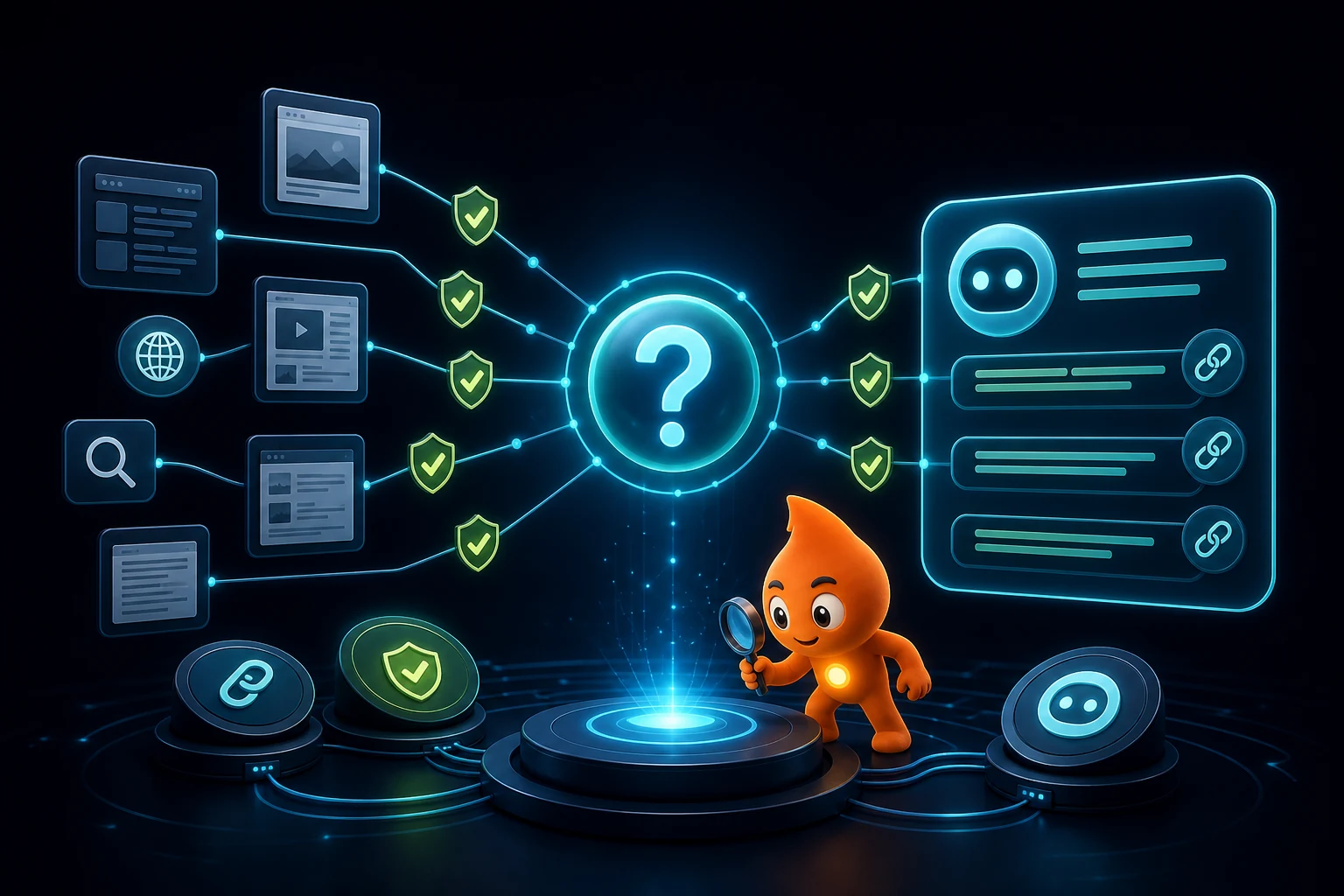
What Perplexity does not publish is how it ranks or selects those sources. Anyone who claims to know Perplexity's ranking factors is inferring them. What can be stated from its documentation is the pipeline:
- Index: PerplexityBot crawls sites to "surface and link websites in search results". If it cannot crawl you, you are absent from that index.
- Live fetch: when a user's question needs a specific page, Perplexity-User may visit it to help answer and link to it.
- Answer: the response is written from the retrieved pages, with citations and links.
From that pipeline, two things are within your control: whether Perplexity can retrieve your pages, and whether your page contains the clearest, most specific answer to the question being asked. The rest of this guide covers both. For how Perplexity compares with ChatGPT and Google, see our AEO and GEO guide.
What is the difference between PerplexityBot and Perplexity-User?
Perplexity documents two user agents on its crawlers page (checked 11 October 2026):
| PerplexityBot | Perplexity-User | |
|---|---|---|
| Job | Surfaces and links websites in Perplexity search results | Supports user actions: visits a page when a user's question needs it |
| Used for model training? | No, per Perplexity | No; "not used for web crawling or to collect content for training AI foundation models" |
| Follows robots.txt? | Yes; Perplexity recommends allowing it | "Generally ignores robots.txt rules", because a user requested the fetch |
| User-agent string | Mozilla/5.0 AppleWebKit/537.36 (KHTML, like Gecko; compatible; PerplexityBot/1.0; +https://perplexity.ai/perplexitybot) | Mozilla/5.0 AppleWebKit/537.36 (KHTML, like Gecko; compatible; Perplexity-User/1.0; +https://perplexity.ai/perplexity-user) |
| IP list | https://www.perplexity.com/perplexitybot.json | https://www.perplexity.com/perplexity-user.json |
| Effect of blocking | Site not indexed for Perplexity search | Only possible at firewall level; Perplexity cannot fetch your page when users ask about it |
The practical reading: PerplexityBot is the one that decides whether you can be found. Perplexity-User matters when someone pastes your URL or asks about a specific page; blocking it at the firewall stops those fetches but also stops Perplexity from quoting you accurately in those conversations. For most businesses that want visibility, allow both.
How do you set up robots.txt and the firewall for Perplexity?
robots.txt
Add an explicit group so a broad rule elsewhere in the file cannot catch it:
User-agent: PerplexityBot
Allow: /
If your file has a User-agent: * group with path exclusions (such as /admin/ or /cart/), repeat those lines under PerplexityBot, because a crawler follows the group that names it. Perplexity says changes to robots.txt may take up to 24 hours to be reflected.
Firewall and CDN
This is where most blocks happen. Perplexity's documentation gives exact patterns:
- Cloudflare: Security → WAF → custom rule. Match User-Agent contains
PerplexityBot(orPerplexity-User) AND IP Source Address is in the official ranges; action Allow. - AWS WAF: create IP sets from the JSON files and string-match conditions on the user agent, combine them in Allow rules, and give those rules higher priority than your blocking rules.
- Always combine user agent and IP. Allowing by user agent alone lets anyone who copies the string through.
- Keep IP lists current by treating the JSON endpoints as the source of truth and updating automatically where you can.
WordPress security plugins and shared-hosting firewalls in India often block unfamiliar bots by default and give no obvious warning. Check 30 days of access logs for "PerplexityBot" and count the status codes: steady 200s are what you want; 403, 429 or 503 means a security layer is interfering. Our AI crawlability audit covers the same checks for OAI-SearchBot, Claude-SearchBot and Googlebot.
What content does Perplexity cite?
Perplexity builds answers from several sources at once. Your page does not need to be the most complete article on the topic; it needs to be the clearest source for part of the answer. Perplexity does not publish selection criteria, so the guidance below combines its documented behaviour (real-time retrieval, numbered citations) with published research and what holds up in practice.
The strongest research signal comes from the GEO paper by Aggarwal et al. (IIT Delhi and Princeton, KDD 2024), which tested content changes on generative engines. It found that adding statistics, quotations and citations to credible sources raised a source's visibility in generative answers by up to 40%, while keyword stuffing did not help.
Page traits that make a passage citable
| Trait | Weak version | Citable version |
|---|---|---|
| Answer placement | Answer in paragraph six after background | Two-to-four sentence answer directly under the heading |
| Specific numbers | "WhatsApp marketing is affordable" | "A marketing message costs ₹0.8631 in India as of October 2026" |
| Date stamps | No date, or "updated" on every page every week | "Prices as of October 2026", changed only when facts change |
| Source links | "Studies show..." | Link to the primary source next to the claim |
| Structure | Long prose comparisons | A table with options, prices and limits |
| Scope | One page covering ten loosely related questions | One page per question, linked to siblings |
| Authorship | "Admin" | Named author with relevant experience |
The WhatsApp figure above comes from our WhatsApp Business API cost guide, which is built on this pattern: rate, date, source, worked example. Because Perplexity retrieves in real time, freshness of facts matters more than for a static index; if your page shows last year's prices, a competitor's current page is the safer source to quote.
Questions worth building pages for
Perplexity users tend to ask research-style questions: comparisons, costs, how-to steps, "is X worth it". For an Indian business, the best candidates are questions where you hold specific facts: "cost of a 2BHK interior in Pune by finish level", "IndiaMART vs TradeIndia for industrial pumps", "how long does UP RERA registration take for a small project". The editorial method is in how to get cited by AI search engines.
What not to do
- Do not add an llms.txt file and expect it to help; Perplexity's crawler documentation does not mention it. See our llms.txt analysis.
- Do not publish statistics without a traceable source. A figure nobody can trace gives a reader, or an answer engine, no reason to trust it over a sourced one.
- Do not hide key text behind JavaScript tabs or in images. Put the answer in the HTML.
What are the Perplexity Publishers Program and Comet?
These come up often in Perplexity SEO discussions, but neither is a route to citations for a typical business website.
- Publishers Program (announced 30 July 2024): Perplexity's announcement describes revenue sharing when Perplexity earns from interactions that reference a partner's content, free API access, Enterprise Pro for partner staff for a year and citation analytics through ScalePost.ai. Launch partners were media and publishing organisations such as TIME, Der Spiegel, Fortune, Entrepreneur, The Texas Tribune and WordPress.com. The contact given is publishers@perplexity.ai; no eligibility criteria are published.
- Comet Plus (announced 25 August 2025): a $5 standalone subscription (about ₹484 at ₹96.72 per US$, the 9 October 2026 close) giving access to content from participating publishers, included in Pro and Max plans. Perplexity says it distributes "all of that revenue to participating publishers, minus a small portion for Perplexity's compute costs".
- Comet browser: Perplexity's AI browser became a free download worldwide on 2 October 2025, according to YourStory, after a limited rollout for paying subscribers.
For a news or media publisher in India, the Publishers Program is worth an email. For a clinic, builder, manufacturer or SaaS company, the work that matters is access and citable pages.
How do you track Perplexity citations and traffic?
Perplexity does not offer a webmaster dashboard showing your citations, unlike Bing's AI Performance report. Use three sources together:
- GA4 referrals. Clicks from Perplexity answers usually arrive as referrals from perplexity.ai. Add it to an "AI assistants" custom channel group placed above Referral; the full regex is in our AI search visibility tracking framework.
- A Perplexity prompt panel. 20–30 buyer questions, run monthly in default mode on the same dates, recording whether your domain is cited, which URL and whether the summary of your page is accurate. Answers vary run to run, so judge trends over three months, not single results.
- Server logs. PerplexityBot visits to new or updated pages tell you whether they have been crawled. Perplexity-User hits on a page tell you real users are asking about it, even when they do not click through.
Finally, pass the source into your CRM through a hidden form field so Perplexity-referred leads can be qualified like any other channel.
A 30-day Perplexity SEO action plan
| Week | Task | Done when |
|---|---|---|
| 1 | Add PerplexityBot group to robots.txt; add UA + IP allow rules in WAF/CDN; check 30 days of logs | PerplexityBot receives 200 responses on priority pages |
| 1 | Add perplexity.ai to the GA4 AI assistants channel; store source in CRM | Referrals visible as their own channel |
| 2 | Write 20–30 buyer questions; run the first Perplexity panel; note which competitor pages are cited | Baseline sheet with dates |
| 3 | Rewrite the 3–5 pages that should answer the most valuable questions: answer first, dated numbers, source links, a comparison table | Each page passes the citable-traits table above |
| 4 | Link updated pages from related pages and service pages; check logs for re-crawl | PerplexityBot has fetched the updated URLs |
| Monthly after | Re-run the panel; fix inaccurate summaries at the source page | Three-month trend available |
Because ChatGPT search follows similar mechanics with different crawlers, many teams run both together; see our ChatGPT search SEO guide. If you prefer us to handle the setup and content, see our AEO and GEO services.
Sources
- Perplexity: Perplexity crawlers: PerplexityBot and Perplexity-User purposes, user-agent strings, IP lists, robots.txt behaviour, Cloudflare and AWS WAF guidance, 24-hour update.
- Perplexity Help Center: What is Perplexity?: real-time web sourcing and citations in every answer.
- Perplexity: Introducing the Perplexity Publishers' Program (30 July 2024): revenue share, API access, ScalePost analytics, launch partners.
- Perplexity: Introducing Comet Plus (25 August 2025): $5 subscription and publisher revenue distribution.
- YourStory: Perplexity makes Comet AI browser free worldwide: 2 October 2025 availability.
- Aggarwal et al., GEO: Generative Engine Optimization: effect of statistics, quotations and citations on visibility.