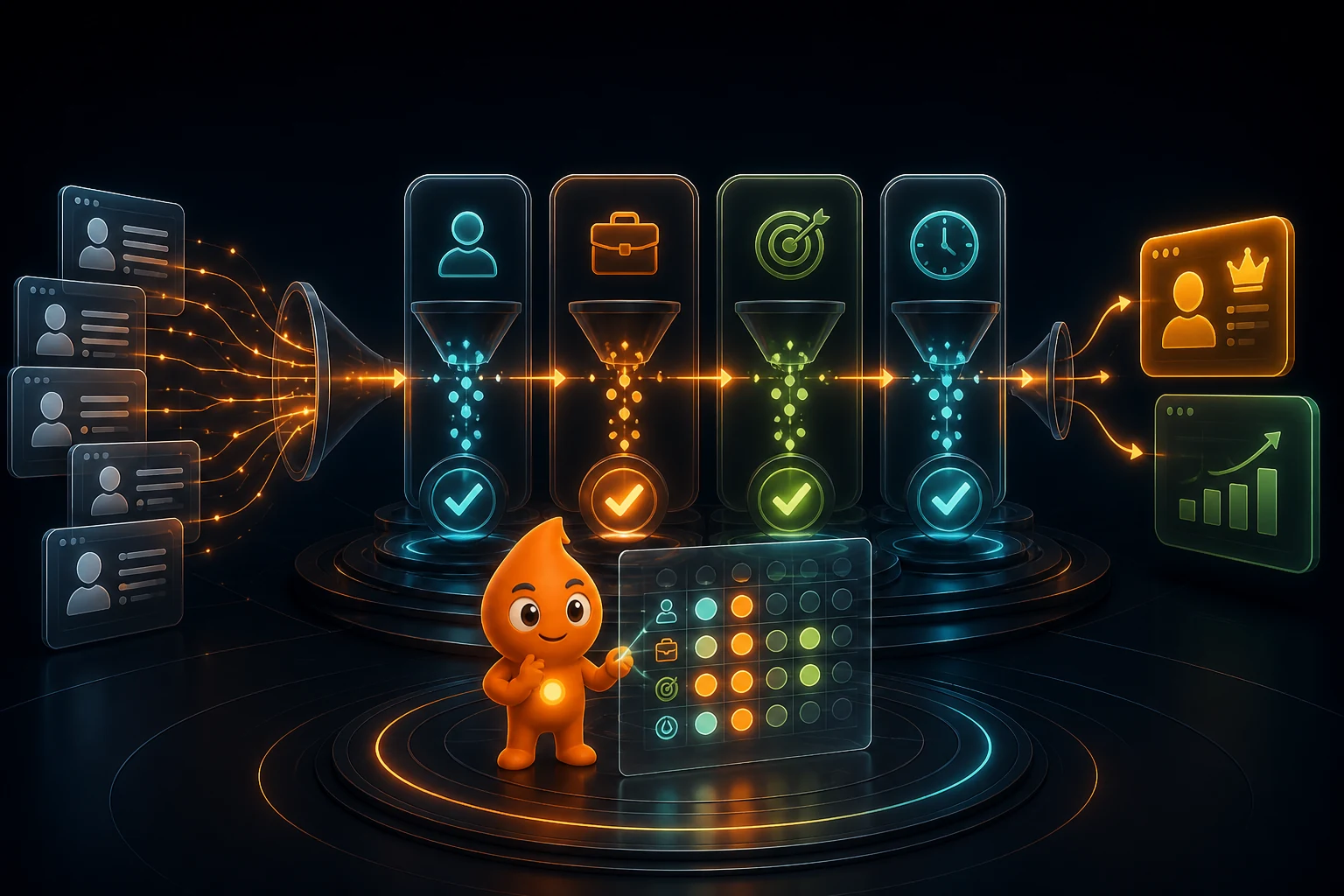
Short answer: A B2B lead qualification framework combines three checks: account fit against your ideal customer profile, intent shown through behaviour, and a sales conversation structured by a method such as BANT, CHAMP, GPCTBA/C&I or MEDDIC. Marketing scores fit and intent to decide which leads become MQLs; sales confirms need, authority and timing in discovery to create SQLs. A written marketing–sales SLA fixes response times, acceptance rules and rejection reasons so both teams use the same definitions.
What is a B2B lead qualification framework?
A B2B lead qualification framework is the agreed set of rules that decides which leads get sales time, in what order, and when a lead becomes pipeline. It works in three layers, and mixing them up causes most qualification arguments:
- Fit: does the company match the ideal customer profile, and is this person in the buying group? Checked from form fields, enrichment and public data.
- Intent: is the account showing buying behaviour now? Demo requests, pricing-page visits, webinar attendance, replies.
- Conversation: does a real need, a route to budget and a timeline exist? Only a human discovery call can confirm this, and this is where BANT, MEDDIC and similar methods apply.
Fit and intent can be scored by software. The conversation layer cannot. A senior job title with heavy website activity can still belong to a company you cannot serve; a quiet lead from a perfect-fit account may be worth a call.
BANT vs MEDDIC vs CHAMP vs GPCTBA/C&I: how do they compare?
All four are conversation frameworks: checklists for what discovery should uncover. HubSpot's sales qualification guide describes each; MEDDIC's creators say it was developed at PTC in 1996.
| Framework | Letters | Starts from | Best fit | Main weakness |
|---|---|---|---|---|
| BANT | Budget, Authority, Need, Timeline | Can they buy? | Short cycles, single decision-maker, inbound demo requests | Early-stage buyers often have no allocated budget yet, so good leads get rejected |
| CHAMP | Challenges, Authority, Money, Prioritisation | What problem do they have? | SMB and mid-market services; consultative sales | Light on the decision process in multi-stakeholder deals |
| GPCTBA/C&I | Goals, Plans, Challenges, Timeline, Budget, Authority, Negative Consequences, Positive Implications | What is the buyer trying to achieve? | Inbound-led B2B SaaS and services where buyers self-educate first (developed at HubSpot) | Long; needs trained reps to avoid sounding like a questionnaire |
| MEDDIC (MEDDICC, MEDDPICC) | Metrics, Economic Buyer, Decision Criteria, Decision Process, Identify Pain, Champion (+ Competition; + Paper Process) | How will this deal actually be decided? | Enterprise deals, many stakeholders, formal procurement | Too heavy for a ₹1 lakh sale; used for deal management more than lead screening |
Two variants come up often: ANUM (Authority, Need, Urgency, Money) reorders BANT to put authority and need first, and FAINT (Funds, Authority, Interest, Need, Timing), from the RAIN Group, swaps "budget" for "funds" to qualify buyers who could find money even without a budget line.
The same discovery, asked four ways
| Framework | Example question for a ₹12 lakh/year software deal |
|---|---|
| BANT | "Is there a budget set aside for this, and who signs off?" |
| CHAMP | "What is the biggest problem with how dispatch works today?" |
| GPCTBA/C&I | "What happens to your service targets this year if nothing changes?" |
| MEDDIC | "Which metric would your CFO use to judge this project a success, and who else must approve the contract?" |
Which qualification framework should you use?
Choose by deal size, cycle length and number of approvers. The bands below are the rule of thumb we use when setting up qualification for clients, not a published standard.
| Your deal profile | Lead stage (SDR / inside sales) | Opportunity stage (account executive) |
|---|---|---|
| Under about ₹2 lakh, one approver, cycle under a month | BANT-lite: need, authority, timeline | Same; no separate method needed |
| About ₹2–25 lakh, two to five people involved, 1–4 months | CHAMP | GPCTBA/C&I |
| Above about ₹25 lakh, procurement or board approval, 4+ months | CHAMP or GPCT (short form) | MEDDICC or MEDDPICC |
Many teams combine them: a short problem-first method for SDRs deciding whether to book a meeting, and MEDDICC for account executives forecasting large deals. What matters is that each letter maps to a CRM field someone fills in, not a mental checklist.
How should you adapt qualification for Indian B2B buyers?
- Budget is often not allocated in advance. In founder- and promoter-led companies, money appears when the owner is convinced. Ask "What would this need to return for you to approve it?" instead of "What is your budget?". This is why CHAMP or FAINT often works better than strict BANT for Indian SMBs.
- Authority sits in two places. The promoter or MD decides; a purchase or accounts team controls vendor onboarding. Record both names.
- The paper process is real even in small deals. Vendor code creation, GST registration details, PAN, Udyam (MSME) certificate, TDS treatment and payment terms can add weeks. MEDDPICC's "Paper Process" question ("What does procurement need from us to raise a PO?") is worth asking in any deal above a few lakh.
- Personal email is not a disqualifier. Founders, consultants and small manufacturers often use Gmail. Route them for review instead of auto-rejecting, and verify the company through public records.
- Timelines track the financial year. Budget conversations cluster around January–March for April starts. A "not now" in November may be a strong "yes" in February, which is what your nurture tracks are for.
What are MQL, SAL and SQL? Definitions you can adopt
HubSpot's default lifecycle stages define an MQL as a contact "your marketing team has qualified as ready for the sales team" and an SQL as one "your sales team has qualified as a potential customer". Those are labels; your team still has to agree the evidence. Add a sales-accepted lead (SAL) step between them so leads cannot vanish between teams.
| Stage | Entry evidence (example) | Owner | Exit |
|---|---|---|---|
| Lead | Known contact with source and consent recorded | Marketing | Scored; becomes MQL or enters nurture |
| MQL | Score grade A1, A2 or B1 (see the scoring model below), or a demo/pricing request from an account with fit ≥20 | Marketing | Passed to sales queue |
| SAL | Sales reviewed the record and agrees it merits outreach | SDR | Contacted within SLA; accepted or rejected with a reason code |
| SQL | Discovery held; need, a decision-maker and a timeline within 6 months confirmed | SDR / AE | Opportunity created or returned to nurture with a date |
| Opportunity | Next commercial step agreed (proposal, pilot, scoping) | AE | Won or lost with a reason |
A booked meeting is not an SQL until it is held and need is confirmed. If an outside team books meetings for you, write that rule into the contract, as our guide to B2B appointment setting explains.
What does a lead scoring model look like? An example with points
The model below is an example for a company selling software to Indian manufacturers with 50–500 employees. Your fields and weights must come from your own won and lost deals. It follows the structure HubSpot uses in its lead scoring tool: separate fit and engagement scores, each capped, with negative points and decay. Salesforce Account Engagement and Zoho CRM scoring rules support similar rule-based scoring.
Fit score (maximum 50)
| Attribute | Value | Points |
|---|---|---|
| Industry | Tier 1 ICP sector (e.g. auto components, pharma manufacturing) | +15 |
| Industry | Tier 2 sector | +8 |
| Company size | 50–500 employees | +10 |
| Company size | 20–49 employees | +5 |
| Role | Founder, director, CXO, VP or plant head | +15 |
| Role | Manager in the relevant function | +8 |
| Geography | Within serviced states | +5 |
| Company verified | Matches an active MCA or GST record | +5 |
| Disqualifier | Student, job seeker, competitor, vendor pitching you | −50 (remove from scoring) |
Engagement score (maximum 50, decays 50% after 3 months of inactivity)
| Action | Points |
|---|---|
| Demo, consultation or pricing request (also routes straight to sales) | +30 |
| Webinar attended (registered only: +3) | +10 |
| Pricing page viewed twice within 7 days | +10 |
| Replied to an email | +10 |
| Case study or comparison page viewed | +5 |
| Guide downloaded (cap 15) | +5 each |
| Email link clicked (cap 10; opens score 0) | +2 each |
| Unsubscribed | −20 |
Thresholds: fit 35–50 = A, 20–34 = B, below 20 = C; engagement 35–50 = 1, 20–34 = 2, below 20 = 3. That gives a nine-cell grid like HubSpot's A1–C3 combined score. A1, A2 and B1 go to sales; A3 and B2 go to nurture; C-grade leads get self-serve content only.
Worked example. The head of operations at a 120-employee auto-component maker in Pune (tier 1, serviced state, GST verified) scores 15 + 10 + 15 + 5 + 5 = 50 fit. She attended a webinar (+10), viewed a case study (+5) and visited pricing twice in a week (+10): 25 engagement. Grade A2: an MQL, passed to sales with the score breakdown attached. A sales manager at a 15-person trading firm who requested a demo scores 0 + 0 + 8 + 5 + 5 = 18 fit and 30 engagement: C2. Because fit is below 20, he is not an MQL; his request is answered by inside sales with a self-serve plan rather than a field visit.
Keep the hard disqualifiers outside the arithmetic. No amount of engagement should turn an unserviceable account into an MQL.
What should a marketing–sales SLA include?
An SLA turns the definitions into commitments both teams can be measured on. The targets below are an example to adapt to your team's capacity.
| Commitment | Owner | Example target |
|---|---|---|
| MQL volume and quality | Marketing | Agreed monthly MQL count, with at least half accepted by sales |
| Context on every MQL | Marketing | Source, campaign, landing page, form answers and score breakdown on the CRM record |
| First response to demo/pricing requests | Sales | Within 1 working hour (call, then email) |
| First response to other MQLs | Sales | Within 1 working day |
| Follow-up attempts | Sales | At least 6 attempts over 10 working days across phone, email and (with opt-in) WhatsApp |
| Accept or reject | Sales | Within 2 working days of first contact, with a reason code |
| Returned leads | Sales → marketing | Every "not now" lead gets a review date and enters a nurture track |
| Review | Both | Weekly 30-minute review of SLA breaches and rejection reasons |
Rejection reason codes (keep the list short and mandatory): wrong company size, wrong industry, outside service area, no need, student/job seeker, duplicate or existing customer, unreachable after 6 attempts, timing (enter nurture). If one reason accounts for most rejections, fix the campaign, form or offer behind it.
The SLA only works if the CRM records the evidence: MQL timestamp, first-touch timestamp, acceptance status and reason. Sending SQL and won-deal stages back to the ad platforms closes the loop; see tracking qualified leads from Google Ads to CRM.
How do you know your qualification framework is working?
Review quarterly by comparing score grades and stages with outcomes. Example review (illustrative numbers):
| Grade | MQLs | Accepted by sales | Opportunities | Won |
|---|---|---|---|---|
| A1 | 40 | 34 (85%) | 14 | 5 |
| A2 | 60 | 39 (65%) | 10 | 3 |
| B1 | 80 | 32 (40%) | 4 | 0 |
In this example B1 leads are being sent to sales but almost never become opportunities, so the engagement points are compensating for weak fit. The fix would be to move B1 into nurture and re-examine which fit attributes the won deals share. Also review false negatives: rejected or low-scored leads that later bought. If several came from one sector or size band, your fit weights are wrong.
Track sales acceptance rate, MQL-to-opportunity rate, median first-response time and win rate by grade on one dashboard. Our lead funnel calculator helps set volume targets backwards from revenue, and our B2B lead generation service includes setting up this scoring and SLA in your CRM.
Sources
- HubSpot, The Ultimate Guide to Sales Qualification: definitions of BANT, CHAMP, MEDDIC, GPCTBA/C&I, ANUM and FAINT.
- MEDDICC, MEDDPICC sales methodology: MEDDIC created at PTC in 1996; MEDDICC and MEDDPICC additions.
- HubSpot Knowledge Base, Use lifecycle stages: MQL and SQL definitions.
- HubSpot Knowledge Base, Understand the lead scoring tool: fit, engagement and combined scores, limits, decay, A1–C3 labels.
- Zoho CRM Help, Scoring rules: rule-based and Zia scoring.
- Salesforce Trailhead, Get started with lead scoring (Account Engagement): activity-based scoring and score decay.