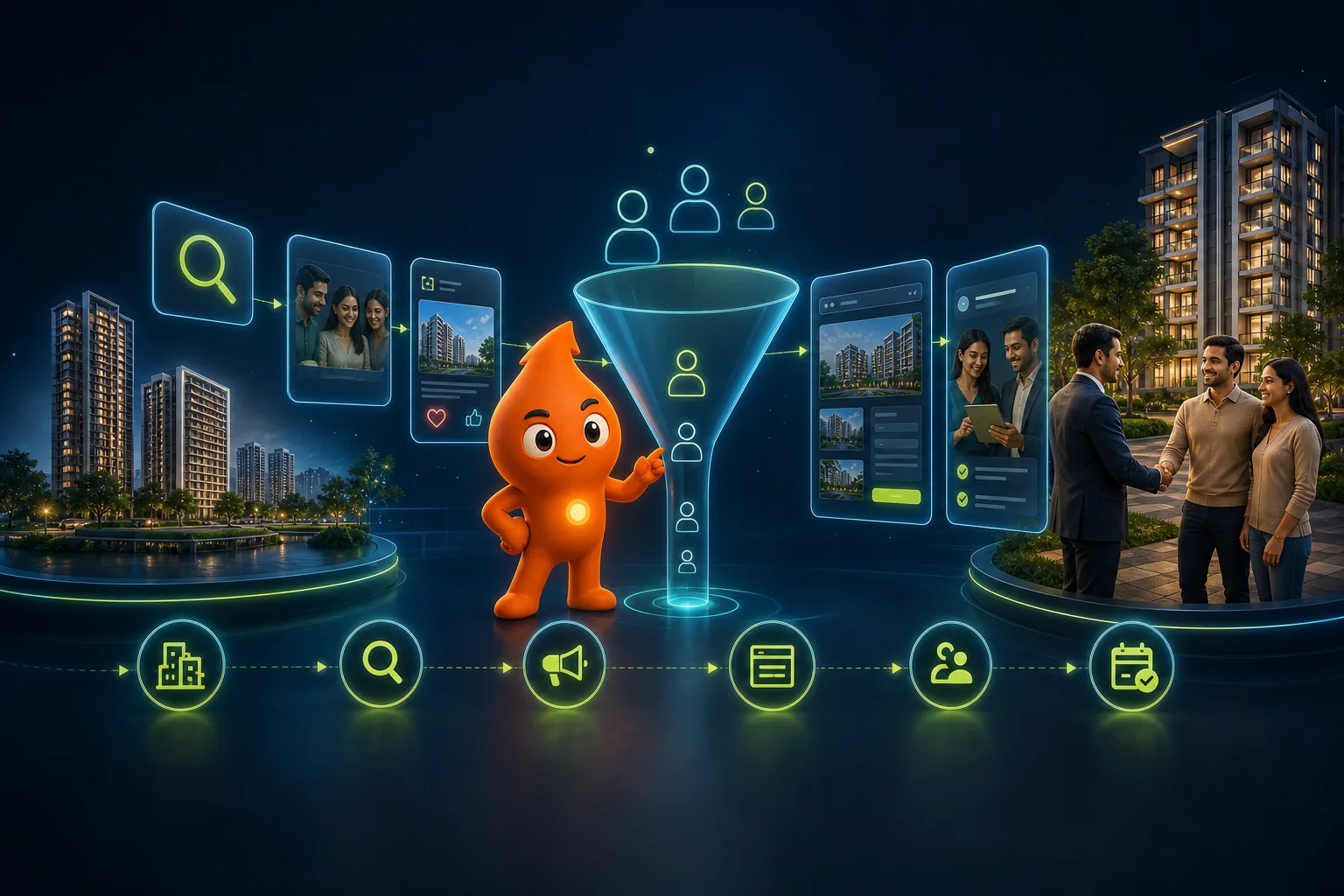
Short answer: To generate real estate leads in India in 2026, give each channel one job. Google Search captures buyers already looking, Meta and YouTube create demand, portals add marketplace visibility, and SEO plus WhatsApp follow-up turn interest into site visits. Every ad must carry the project's RERA registration number (Section 11(2) of the RERA Act, 2016). Optimise budgets on completed site visits and bookings, not cost per lead.
What does the 2026 housing market mean for lead generation?
Developers are competing harder for the same buyers. Knight Frank data reported by Business Standard (5 October 2026) shows January–September 2026 sales across India's top eight cities flat at 258,238 units, while launches rose 4% to 279,899. NCR was the only major market to decline (−11%). Quarters-to-sell, a measure of unsold inventory, rose to 6.1 from 5.8.
The buyer mix is moving upmarket too. Homes above ₹1 crore made up 55% of sales, the ₹1–2 crore band was the largest single category (77,087 units), and sub-₹50 lakh sales fell 14%. In practice:
- Premium and mid-segment projects face more bidders on the same locality searches, so landing-page conversion and follow-up speed decide cost per visit.
- Affordable projects can still buy cheap leads, but fewer of those buyers are ready to act. Qualification at capture matters more than lead volume.
- At 6.1 quarters-to-sell, a typical project needs about 18 months of steady marketing after launch, not just a launch burst.
Who are you selling to? Define segments before channels
Start from the project's inventory, location, price band and possession status, then split buyers by the question each one is trying to answer. Each segment needs its own message, proof and landing page.
| Segment | Main question | Proof that works | Best first channel |
|---|---|---|---|
| First-time end user | Can I afford it, and is it safe to buy? | All-in price, EMI example, RERA details, bank approvals | Meta lead ads, Google locality search |
| Upgrader | Is this better than where I live now? | Floor plans, carpet area, school and office commute times | Google Search, YouTube walkthroughs |
| Investor | What rental yield and appreciation can I expect? | Locality supply data, rental comparables (no guaranteed returns) | Google Search, portals |
| NRI buyer | Can I trust the developer from abroad? | Construction updates, video calls, documentation process | Meta and Google targeted at Gulf, UK, US and Canada; WhatsApp |
For NRI campaigns, check Meta's targeting rules. Meta's special ad category restrictions for housing apply to advertisers targeting the US, Canada and Europe: age is fixed at 18–65+, gender cannot be targeted, and lookalike audiences, detailed targeting exclusions and ZIP-level targeting are unavailable. Plan separate ad sets for those markets.
How do you run lead generation and PPC for real estate investors and NRIs in India?
Lead generation for real estate investors in India needs a different brief from end-user campaigns. Investors compare locations, yields and exit options rather than floor plans, and NRI investors add two questions of their own: whether they are allowed to buy, and how they will pay. Answer both on the landing page before asking for a phone number.
Eligibility and payment, stated correctly. Under the RBI's Master Direction on acquisition of immovable property under FEMA, an NRI or OCI can buy residential or commercial property in India, but not agricultural land, plantation property or a farm house. Payment must come through banking channels: an inward remittance or a debit to an NRE, FCNR(B) or NRO account. A plot-project ad aimed at NRIs should therefore make clear that the land is non-agricultural.
| Element | Resident investor campaign | NRI investor campaign |
|---|---|---|
| Google Search keywords | "commercial shop for investment [corridor]", "pre-leased office [city]", "[locality] rental yield" | Project and locality names plus "NRI", "for NRI" and "investment"; add project-name keywords for buyers who already know the project |
| Location setting | Target cities in India with "Presence" | Target the Gulf, UK, US, Canada or Singapore with "Presence"; Google's location options default to "Presence or interest", which also reaches people merely interested in a place |
| Ad schedule | Indian evenings and weekends | The buyer's local evening; the UAE is 1.5 hours behind IST, so a 9 pm Dubai click lands at 10:30 pm in India |
| Landing page proof | Rental comparables, supply pipeline, RERA number, possession date | All of that plus video walkthroughs, construction updates, the payment route and power-of-attorney process |
| Qualification fields | Budget, timeline, self-funded or loan | Country of residence, budget, timeline, preferred call time (with time zone) |
| Conversion to optimise | Completed site visit | Completed video site visit or a visit by family in India |
Two rules apply to every investor ad. First, do not promise returns: RERA's Section 12 makes the promoter liable for false statements in an advertisement, so a line such as "assured 12% yield" is a risk unless it is a written, enforceable commitment. Use dated rental comparables instead. Second, PPC for real estate investors works best on Google Search, because investors research before they enquire; use Meta mainly to retarget people who viewed the investment page, and remember the housing special ad category limits above when you target North America or Europe.
Which channels generate real estate leads in India? The channel mix
| Channel | Job in the funnel | Cost reference | What to watch |
|---|---|---|---|
| Google Search | Capture active demand: locality + configuration, project name, developer comparisons | CPL ₹300–2,500 (Sell.do 2026 ranges) | Search-term waste (rent, PG, jobs); low page conversion. US benchmarks put agent and broker search conversion at only 1.3–1.8% (LocalIQ) |
| Meta lead ads (Facebook + Instagram) | Create demand with visual stories; reach buyers not yet searching | CPL ₹150–2,000 (Sell.do) | Fake and accidental leads; use higher-intent forms and qualifying questions |
| Click-to-WhatsApp ads | Start a conversation instead of a form | Sell.do reports up to 40% lower effective CPL than forms | Needs a team or bot that replies within minutes |
| Property portals (99acres, MagicBricks, Housing.com) | Marketplace visibility where buyers compare | Package-based; see our real estate lead generation cost guide | Shared enquiries: the buyer contacts several listings |
| YouTube and video | Walkthroughs, location stories, retargeting pools | Media-dependent | Judge on assisted visits, not direct leads |
| SEO and local search | Rank for locality, project and buying-question searches | Content and technical cost, no media | Takes months; build it before the next launch |
| Remarketing | Bring back brochure viewers and engaged visitors with a site-visit offer | Small share of budget | Frequency caps; different message per intent level |
| Channel partners / brokers | Bring buyer networks, especially for resale-minded investors | Commission-based | Lead ownership rules and duplicate claims |
Do not reuse the same creative and landing page across channels. Search visitors need a page that matches their query. Social audiences need context on why the project matters. Portal leads need a fast call because they are comparing. Our real estate SEO and local search guide covers the organic side.
What RERA advertising rules apply to digital campaigns?
RERA is the one area where a marketing mistake becomes a legal one. The core rules come from the Real Estate (Regulation and Development) Act, 2016:
- Section 3(1): no promoter may "advertise, market, book, sell or offer for sale" a project that must be registered until it is registered with the state RERA authority. Pre-launch or "EOI" ads for an unregistered project fall inside this rule (AP RERA advertisement guidelines).
- Section 11(2): every advertisement or prospectus must prominently mention the Authority's website address, where the registered project's details are listed, and the registration number obtained from the Authority. HARERA Gurugram applied this in a 2024 suo-motu show cause notice against a promoter whose ad omitted the Authority's website. That case also cited Section 61, which allows a penalty of up to 5% of the project's estimated cost.
- Section 12: if a buyer is misled by a false statement in an advertisement and withdraws, the promoter must return the investment with interest.
States add their own display rules:
| State authority | Rule | Source |
|---|---|---|
| MahaRERA (Maharashtra) | Registration number and a QR code linking to the project's MahaRERA page in all ads, including social media. QR code in the top-right corner. Fines up to ₹50,000; a 10-day window to fix | Realty Today, April 2025 |
| WBRERA (West Bengal) | Registration number and WBRERA website in the top-right quadrant, with font at least one-third the size of the project name. Also applies to FM radio, electronic media and WhatsApp | LiveLaw, March 2024 |
| AP RERA (Andhra Pradesh) | Registration number on the website and every advertisement; "RERA REGISTERED" details displayed | AP RERA guidelines |
Digital checklist we use before any campaign goes live: registration number and Authority website in every image and video creative; the same on the landing page above the fold; the QR code where the state requires it; no guaranteed returns or possession dates that differ from the RERA filing; and a copy of every creative version saved with its approval date. State rules change through circulars, so have the developer's legal team confirm the current requirement in your state. Our RERA-aware advertising checklist goes deeper.
What does a launch-phase plan look like?
| Phase | Timing | Objective | Channel emphasis | KPI to judge |
|---|---|---|---|---|
| Foundation (post-registration) | Weeks −6 to −1 | Build pages, tracking, CRM stages, creative, WhatsApp flows; seed audiences | Landing pages, SEO pages, small Meta awareness tests | Page speed, form completion, tracking verified end to end |
| Launch | Weeks 1–6 | Maximise qualified enquiries and site visits while interest is highest | Google Search (locality + project name), Meta lead ads, click-to-WhatsApp, portal featured slots | Cost per completed site visit; first-response time |
| Optimise | Weeks 7–12 | Shift budget to sources producing visits and bookings | Best-performing search terms, remarketing with site-visit offer, YouTube walkthroughs | Cost per booking by lead cohort |
| Sustenance | Month 4 onward | Steady flow at lower cost; clear remaining inventory | SEO, brand search, remarketing, construction-update content, channel partners | Bookings per month vs. inventory plan |
We hold back 15–20% of the launch budget as a reserve, because the first three weeks of visit data often point to a different channel than the plan assumed.
How do you turn real estate leads into site visits?
Property buyers take weeks or months to decide, compare several projects and usually need family agreement. A campaign that treats every enquiry as ready to buy wastes budget. Four practices make the biggest difference:
- Segment landing pages by unit type and budget. Separate 2BHK, 3BHK and investor pages so the lead arrives pre-qualified and the first call can be specific. Our landing page guide covers layout and form design.
- Reply on WhatsApp in seconds, not hours. Send the brochure, floor plans and a site-visit booking link automatically, then call. Buyers enquire with several projects at once, so the first useful response often wins the first visit. See WhatsApp automation for real estate leads.
- Retarget by intent. Someone who opened the brochure but has not booked needs a site-visit offer, not the same launch ad again. Keep cold and warm audiences in separate campaigns.
- Optimise toward booked and completed visits. Import visit outcomes from the CRM as offline conversions and reallocate weekly toward ad sets that produce visits.
Capture budget band, preferred configuration and purchase timeline on the form, then route by project and language. Our real estate CRM and lead management guide has a stage model you can copy.
What should you measure?
| Stage | Metric | Diagnostic question |
|---|---|---|
| Acquisition | Cost per valid lead (reachable, non-duplicate, in budget) | Is the right audience reaching the right project? |
| Response | Median first-response time; contact rate | Are we reaching people while they are still interested? |
| Qualification | Qualified conversations ÷ valid leads | Do budget, location and timeline match? |
| Intent | Site visits scheduled and completed; cost per completed visit | Is digital interest becoming real evaluation? |
| Commercial | Bookings and cost per booking by source and lead month | Which sources create revenue? |
Store source, campaign ID, landing page, first-response timestamp, disposition reason and visit status on every CRM record. Judge long buying cycles by monthly cohort so leads from launch week are not written off before they mature.
How do you choose among real estate lead generation companies in India?
Ask every agency or vendor these questions before you sign:
- What is a "lead"? Get a written definition covering duplicates, wrong numbers, out-of-budget buyers and a replacement rule.
- Can you show visit and booking data? CPL screenshots alone prove nothing. Our ILeadGuru case study reports a 30% lead-to-deal rate for a broker programme, the kind of downstream number to ask for.
- Who owns the ad accounts, pixels, pages and CRM data? You should, from day one.
- How do you handle RERA? Expect a creative checklist and an approval log, not a shrug.
- Are the leads exclusive? Shared or resold leads, including purchased databases, create consent and quality problems.
Red flags include guaranteed booking numbers, "pre-launch" ads before RERA registration and refusal to give you account access. Our real estate lead generation agency selection guide covers contracts and pricing models in detail.
Sources
- AP RERA: Provisions of the RERA Act, 2016 on advertisements: Section 3(1), Section 11(2) and Section 12 requirements
- HARERA Gurugram: suo-motu complaint RERA-GRG-549-2024: Section 11(2) wording on Authority website; Section 61 penalty up to 5% of project cost
- Realty Today: MahaRERA QR code and registration number order: Maharashtra QR placement and ₹50,000 penalty
- LiveLaw: West Bengal RERA mandate on registration details in ads: one-third font-size and placement rule
- Business Standard: Knight Frank 9M 2026 housing data: sales, launches, price-band mix and quarters-to-sell
- Meta for Developers: Special ad category: housing targeting restrictions in the US, Canada and Europe
- RBI Master Direction: Acquisition or transfer of immovable property under FEMA: what NRIs and OCIs may buy and permitted payment channels
- Google Ads Help: location options: "Presence" vs "Presence or interest" targeting
- Sell.do: Paid lead generation for real estate in India, 2026: Indian Google and Meta CPL ranges
- LocalIQ: Real estate search advertising benchmarks: search conversion rates for agents and brokers