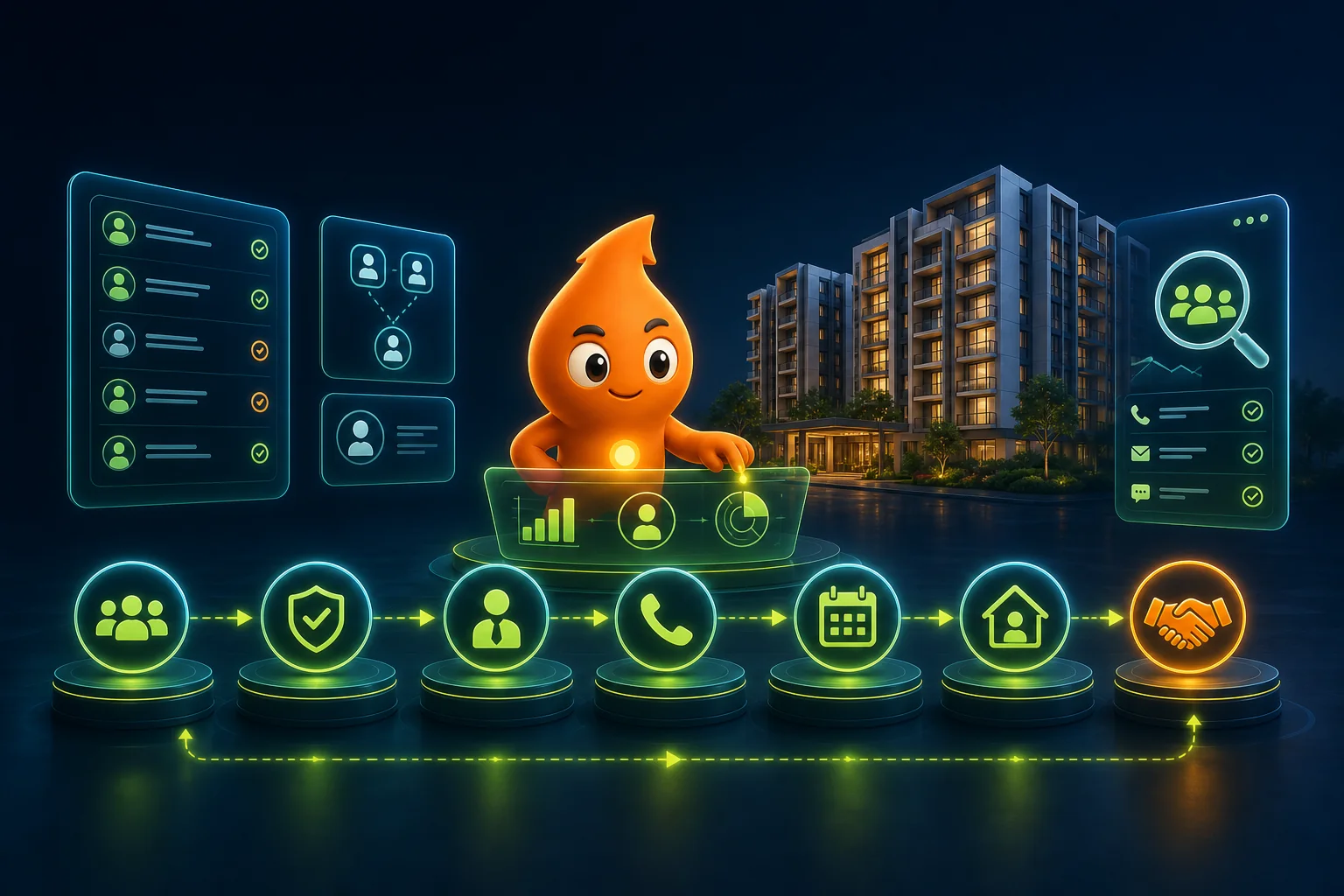
Short answer: Real estate lead management is the process of capturing every property enquiry in one CRM, assigning it to the right advisor within minutes, qualifying it on budget, configuration, location and timeline, and tracking it through site visit to booking with a recorded reason at every exit. A working setup needs about nine pipeline stages with written entry rules, 15–20 mandatory fields, assignment rules by project and capacity, response SLAs measured in minutes, and a weekly report from enquiry to booking.
What does real estate lead management actually cover?
Lead management for real estate runs from the first form, call, WhatsApp message or portal enquiry to a booking or a documented loss. In between, the CRM should enforce who owns the lead, how fast they respond, what counts as qualified, when a site visit is real and when to stop calling.
Property is harder than most categories for three reasons. The same family enquires on three or four channels, so duplicates are normal rather than rare. Decision cycles run from days (ready-to-move resale) to a year or more (under-construction launches), so the CRM must handle both hot and slow leads without mixing them. And portal leads are often sent to several sellers at once; a portal comparison published by CRM vendor ClosingFox (July 2026) reports brokers' estimates of 4–15 recipients per enquiry in busy metro markets, which makes response speed the deciding factor.
This guide covers the CRM side. Qualification questions and site-visit scripts are in our lead qualification guide, and the long-cycle follow-up cadence is in the nurturing playbook.
Which pipeline stages should a real estate CRM use?
Use stages that describe something observable, not a salesperson's feeling. Each stage below has an entry rule (what must be true and recorded) and a time limit after which the CRM flags the record. The time limits are our starting defaults for a primary-sales project; tighten or relax them with your own data.
| Stage | Entry rule (must be recorded) | Time limit before flag | Typical exit |
|---|---|---|---|
| 1. New | Phone normalised to +91, source, campaign, project | 5 minutes (business hours) | Attempted |
| 2. Attempting contact | At least one call attempt logged with outcome | 48 hours / 6 attempts | Connected or Unreachable |
| 3. Connected | Two-way conversation held; buyer confirmed the enquiry | 24 hours | Qualified, Nurture or Disqualified |
| 4. Qualified | Budget band, configuration, location fit and timeline captured; fits at least one project | 7 days | Visit scheduled or Nurture |
| 5. Visit scheduled | Date, slot, project, attendees, advisor; confirmation sent | Visit date + 1 day | Visit done, Rescheduled or No-show |
| 6. Visit done | Attendance verified (sales-office check-in, OTP or advisor photo log) and feedback recorded | 3 days to next action | Negotiation, Revisit or Nurture |
| 7. Negotiation / revisit | Unit shortlisted or cost sheet shared; family or loan step identified | 14 days | Booked or Lost |
| 8. Booked | Token or booking amount received; unit number recorded | Hand over to post-sales | Agreement, Cancelled |
| 9. Nurture / Lost | Reason code and review date (Nurture) or loss reason (Lost) | Review date | Back to Connected, or closed |
Two rules keep this honest. Keep "Visit scheduled" and "Visit done" separate, because counting scheduled visits as visits is the commonest way a campaign looks better than it is. And block Lost or Nurture without a reason code from a fixed list; free-text reasons cannot be counted.
Reason codes worth standardising
- Disqualified: wrong number, did not enquire, broker or channel partner, job seeker, wants rental, outside budget, outside location, duplicate.
- Nurture: timeline beyond 3 months, waiting for loan sanction, waiting for sale of current home, family decision pending, comparing projects.
- Lost: bought elsewhere (record which project), price, possession date, location, loan rejected, stopped responding after visit.
What fields should every real estate lead record have?
Every field needs a purpose: routing, qualification, reporting or compliance. If a field serves none, delete it. Make the starred ones mandatory at the stage shown, otherwise reps skip them and your reports go blank.
| Field | Type and allowed values | Mandatory from | Used for |
|---|---|---|---|
| Mobile* | E.164 format (+91XXXXXXXXXX), validated | New | Dedupe, WhatsApp, call tracking |
| Project of interest* | Picklist of live projects | New | Routing, reporting |
| Original source* / latest source | Picklist: Google Search, Meta form, Click-to-WhatsApp, 99acres, MagicBricks, Housing.com, website organic, walk-in, referral, channel partner | New | Cost per visit by channel |
| Campaign, ad set, keyword, GCLID / Meta lead ID | Auto-filled from UTM and hidden fields | New | Sending outcomes back to ad platforms |
| Channel partner name and RERA agent number | Lookup to partner master | New (if CP-sourced) | Brokerage, conflict rules |
| Configuration* | Plot / 1, 2, 3, 4 BHK / villa / commercial | Qualified | Inventory match |
| Budget band* | Bands that match your price sheet (e.g. under ₹60 lakh, ₹60 lakh–1 crore, ₹1–1.5 crore) | Qualified | Project match, scoring |
| Purchase timeline* | 0–1 month, 1–3, 3–6, 6+ months | Qualified | Cadence selection |
| Purpose | Self-use / investment / NRI | Qualified | Messaging |
| Funding | Own funds / loan pre-approved / loan not started | Qualified | Readiness |
| Decision makers | Self / spouse / parents / partner | Visit scheduled | Who must attend the visit |
| Owner and first-response timestamp | System fields | New | SLA reporting |
| Visit date, visit status, check-in proof | Date, picklist, file | Visit scheduled | Completed-visit reporting |
| Communication consent | Call / WhatsApp / email, with timestamp and wording version | New | Permitted channels, opt-out |
| Loss or nurture reason* | Fixed reason codes | Lost / Nurture | Feedback to marketing |
Consent and retention belong in the data model, not in a policy document. Under the Digital Personal Data Protection Act, 2023, the business that decides why data is processed must erase it once the purpose is no longer served or consent is withdrawn (Section 8(7)), and stays responsible for anything a vendor processes on its behalf (Section 8(1)). The DPDP Rules notified in November 2025 phase most of these obligations in over 18 months. A "review date" on Nurture records and a purge rule for long-dead Lost records are the practical way to meet that.
How should real estate leads be assigned?
Round-robin alone is fair but blind: it gives a ₹4 crore villa enquiry to the newest rep and a Kannada-speaking buyer to someone who only speaks Hindi. Build assignment as an ordered set of rules, evaluated top to bottom:
- Existing owner wins. If the mobile number matches an open record, attach the new enquiry as an activity and notify the current owner. Never create a second lead for the same buyer and project.
- Channel partner protection. If the buyer was registered by a partner within your protection window (commonly 60–90 days; set yours in the CP agreement), route to the CP manager, not the open pool.
- Project team. Route by project, then by tower or product (plots vs apartments) if teams are split.
- Language and geography. NRI enquiries to the NRI desk with time-zone-aware calling; regional-language buyers to reps who speak it.
- Weighted round-robin by capacity. Cap open "New + Attempting" leads per rep (for example 25). A rep at the cap is skipped until they clear records.
- Reassignment. If the first-call SLA is missed, the lead moves to the next available rep and the miss is logged against the first owner.
Check what your CRM can actually do before designing the rules. In Zoho CRM, for example, assignment rules and Blueprint process enforcement start at the Professional edition (three active Blueprints), not Standard. Duplicate handling deserves its own design; our guide to reducing fake and duplicate real estate leads has the normalisation and merge rules.
What response SLAs should a real estate sales team set?
Speed matters most where leads are shared. The ClosingFox comparison argues that with shared portal enquiries, the broker who calls within two minutes usually wins, and Sell.do's 2026 paid lead generation guide says a lead called within a minute converts several times better than one called an hour later (neither publishes a method, so treat these as practitioner claims). These are the SLAs we set as defaults:
| Lead source | First call within | Attempt pattern if unanswered | Escalate when |
|---|---|---|---|
| Portal enquiry (shared) | 5 minutes | Call + WhatsApp at once; retry at 30 min, 3 h, next morning | No attempt in 10 minutes |
| Google Search form or call-back | 5 minutes | Retry at 1 h, 4 h, next day 10 am and 6 pm | No attempt in 15 minutes |
| Meta instant form | 15 minutes | WhatsApp utility message first, then calls at 1 h, next day twice | No attempt in 30 minutes |
| Click-to-WhatsApp chat | Bot reply instantly; human within 15 minutes | Keep in chat while the 24-hour window is open | Unanswered chat after 30 minutes |
| Missed inbound call | 10 minutes | Call back twice the same day | No call-back in 30 minutes |
| After-hours enquiry | Acknowledge instantly; call by 10:30 am next day | As per source | Not called by noon |
Measure SLA from lead creation to the first logged call attempt, and report the share of leads inside SLA per rep. An automated WhatsApp acknowledgement does not count as a response; flows and template costs are covered in WhatsApp automation for real estate leads.
Which CRM should you use for real estate lead management?
Choose between two families. Real-estate-specific CRMs bundle inventory, cost sheets, channel partner management and post-sales, which developers need. General CRMs are cheaper and flexible, which suits brokers and small teams, but you build the property logic yourself. Prices below are from each vendor's pricing page as checked on 11 October 2026, exclude GST, and are converted at ₹96.72 per US$ (9 October 2026 close) where listed in dollars.
| CRM | Type | Published price | Relevant for real estate |
|---|---|---|---|
| Sell.do | Real-estate specific | Quote only: per active user per month, minimum 5 users; WhatsApp, telephony, SMS and AI are usage-based add-ons | Full suite includes inventory, channel partner management and post-sales modules |
| LeadSquared | Industry CRM with real estate solution | Sales Pro US$60, Sales Super US$100 per user/month, billed annually (about ₹5,803 and ₹9,672) | Lead distribution and assignment quotas in both plans |
| Salesforce | General, highly configurable | Starter Suite US$25, Pro Suite US$100 per user/month (about ₹2,418 and ₹9,672); mostly annual contracts | Needs a partner to build property objects; suits large developers |
| Zoho CRM | General | Standard ₹800, Professional ₹1,400, Enterprise ₹2,400 per user/month; free for up to 3 users | Assignment rules and Blueprint from Professional |
| Bigin by Zoho | Pipeline CRM for small teams | Express US$7, Premier US$12 per user/month billed yearly (about ₹677 and ₹1,161) | 3–5 team pipelines; good for a 2–5 person broker office |
| Kylas | General, Indian | Free Embark plan; Elevate listed as a flat ₹12,999 plan with unlimited users | Automated and location-based lead routing on Elevate |
Worked example: an 8-person team on Zoho CRM Professional costs 8 × ₹1,400 = ₹11,200 a month before GST; on LeadSquared Sales Pro it is about 8 × ₹5,803 = ₹46,424 a month, billed annually. The difference buys a ready-made real estate setup, worth it if you would otherwise pay a consultant to build one. Telephony and WhatsApp costs come on top. If WhatsApp is central to your sales process, our comparison of the best CRMs for WhatsApp lead management covers which plans include it.
Five tests to run in a CRM demo
- Submit the same mobile number from a Meta form and a 99acres enquiry: does it merge into one record with both sources kept?
- Miss the SLA on a test lead: does it reassign automatically, and is the miss reported?
- Mark a lead Lost without a reason: does the CRM block it?
- Book a site visit: does the buyer get a confirmation and the advisor a reminder without manual work?
- Export the lead stages with GCLID and Meta lead ID: can you send them back to the ad platforms daily?
How do CRM stages improve Google and Meta campaigns?
Ad platforms optimise toward whatever you report. If they only see form fills, they find people who fill forms. Send your CRM stages back so bidding learns which leads become visits.
- Meta: the Conversion Leads integration uses CRM stage events for Instant Form leads. Meta asks for at least 200 leads a month, a target stage that happens within 28 days of the lead and converts 1–40% of leads, and uploads at least daily. For most projects, "Qualified" or "Visit scheduled" fits those limits better than "Booked".
- Google: since 15 June 2026, offline conversion and enhanced-conversions-for-leads uploads go through the Data Manager API, and Google recommends Data Manager as the setup path. Upload "Qualified" and "Visit done" as separate conversion actions with values.
The setup steps are in our guide to offline conversion tracking for Google Ads.
Which reports should you review every week?
One table, cut by source and by project, answers most questions. Use cohorts (leads created in a given week) rather than activity in the week, otherwise a busy weekend of visits from old leads hides a weak new month.
| Metric | Formula | What a bad number usually means |
|---|---|---|
| Contact rate | Connected ÷ new leads | Fake numbers or slow first call |
| SLA compliance | Leads called within SLA ÷ new leads | Capacity or assignment problem |
| Qualification rate | Qualified ÷ connected | Targeting or landing page mismatch |
| Visit show rate | Visits done ÷ visits scheduled | Weak confirmation or premature booking |
| Visit-to-booking | Bookings ÷ visits done | Product, price or closing problem, not marketing |
| Cost per visit done | Total spend ÷ visits done | The number to compare channels on |
| Top 3 loss reasons | Count by reason code | Feeds creative, targeting and pricing decisions |
Our ILeadGuru programme reached a 30% lead-to-deal rate largely because budget, location and timeline were captured before a lead reached the broker, and budgets moved on lead progression rather than form volume. The CRM structure above is what makes that kind of reallocation possible.
How do you roll out real estate lead management in 30 days?
- Days 1–5: agree stages, reason codes and SLAs with the sales head in writing; map how every source reaches the CRM (API, webhook, portal integration, email parser).
- Days 6–12: configure fields, assignment, duplicate rules and notifications; add hidden UTM, GCLID and Meta lead ID fields to forms.
- Days 13–18: test 20 dummy leads, including a duplicate, an after-hours lead, a missed SLA and a channel-partner lead.
- Days 19–30: train reps on real scenarios, go live on one project, audit 30 random records daily, publish the first cohort report, then switch on the offline conversion feed.
If you want this set up and run alongside your campaigns, our sales enablement and CRM follow-up service covers configuration, SLA monitoring and the ad-platform feedback loop.
Sources
- Sell.do pricing: quote-based pricing, per active user, minimum 5 users, usage-based add-ons.
- LeadSquared Sales CRM pricing: Sales Pro and Sales Super prices, lead distribution features.
- Salesforce India small business pricing: Starter and Pro Suite prices.
- Zoho CRM pricing and Zoho CRM edition comparison: INR edition prices; assignment rules and Blueprint availability.
- Bigin pricing: plan prices and pipeline limits.
- Kylas pricing: plans and routing features.
- Meta Conversion Leads integration: 200 leads/month, 28-day stage window, 1–40% rate, daily uploads.
- Google Ads: About enhanced conversions for leads: Data Manager API migration from 15 June 2026.
- Digital Personal Data Protection Act, 2023: Sections 8(1) and 8(7) on processor responsibility and erasure.
- ClosingFox: 99acres vs MagicBricks vs Housing.com: broker estimates of shared portal leads and response speed.
- Sell.do: paid lead generation for real estate in India, 2026: speed-to-lead claim.