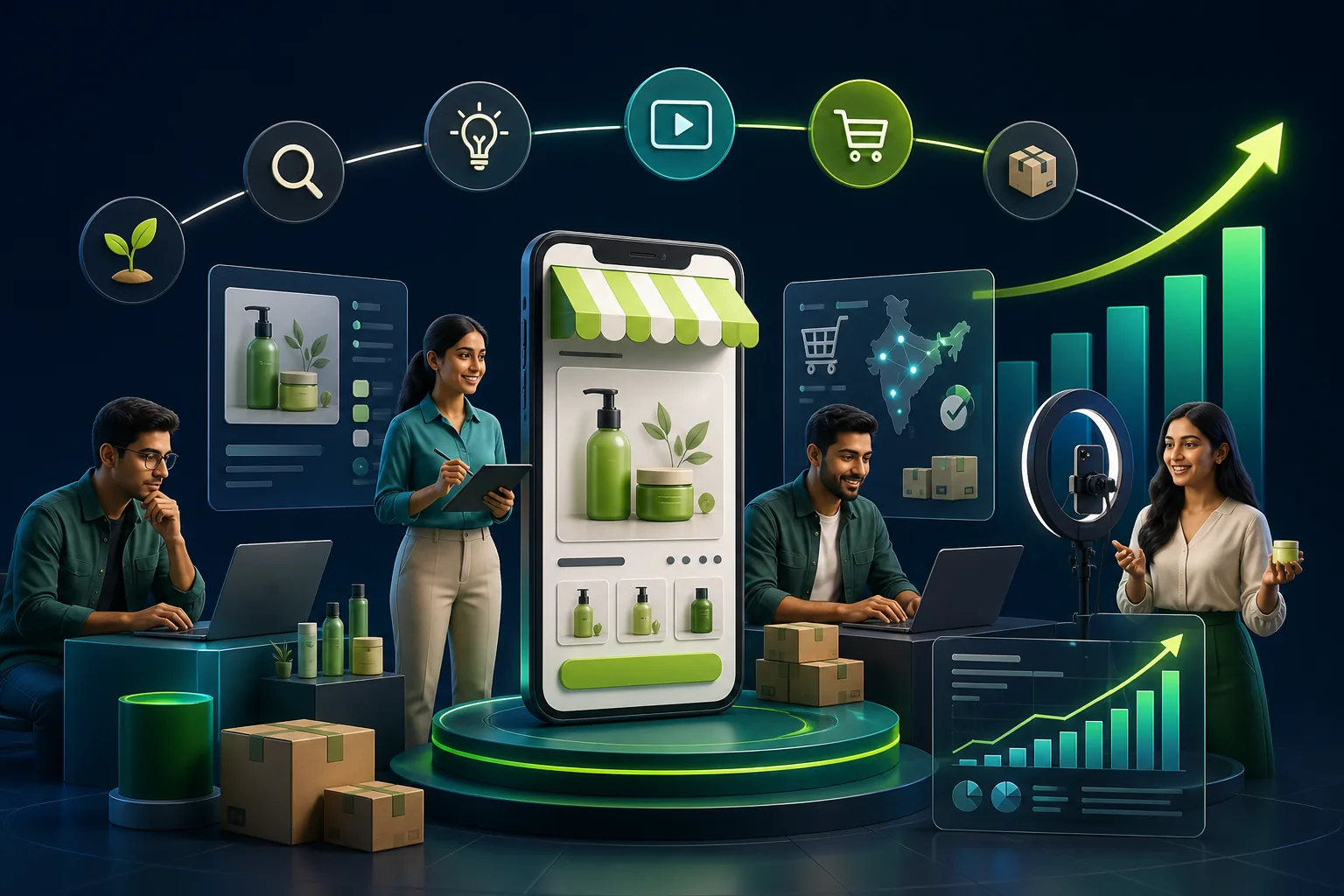
Short answer: To market a new D2C brand in India from zero, do the work in this order. Lock one hero product and one sharp positioning line, collect proof before spending on ads, and sell on a marketplace and your own site from day one (marketplaces for demand, your site for margin and customer data). Then test Meta prospecting, Google brand and category search and creator seeding on a fixed 90-day budget. Expect the first order to roughly break even. The profit comes from the second order, so set up WhatsApp and email retention before you scale spend.
What is the right order to market a new D2C brand in India?
Most launches that burn money do the steps out of order: they buy traffic before the product page, the proof or the tracking is ready. The sequence below is the one we use for brands starting with no customers, no reviews and no pixel data.
| Phase | Weeks | Goal | Done when |
|---|---|---|---|
| 1. Position and prove | 0–4 | One hero SKU, one promise, first 20–50 honest reviews from friends-and-network and seeded users | You can state who it is for and why it beats the default choice in one sentence |
| 2. Set up sales channels | 3–6 | Own site live with tracked checkout; marketplace listing live | A test order on each channel shows up correctly in GA4 and the ad platforms |
| 3. Paid tests | 6–14 | Find one channel, audience and creative angle that acquires customers at or near first-order break-even | CAC and first-order contribution measured across at least 100 orders |
| 4. Retention and scale | 10–17+ | Second-order rate rising; scale spend only on what pays back within your cash window | 90-day revenue per customer exceeds CAC |
Set up the paperwork alongside phase 1. If you incorporate as a private limited company or LLP, check DPIIT startup recognition. Startup India lists eligibility as up to 10 years from incorporation and turnover under ₹200 crore in every previous financial year, plus work on innovation or improvement of a product, service or process. Recognised companies and LLPs incorporated after 1 April 2016 can apply for the Section 80-IAC tax holiday for 3 consecutive years out of their first 10. Not every D2C brand qualifies, since recognition needs an innovation or improvement element, but it costs little to check.
How do you position a new D2C brand so ads have something to say?
A new brand cannot win on "premium quality, natural ingredients, affordable price". Every competitor in the category says the same thing. Positioning needs a specific customer, a specific problem and a reason to believe. Fill in this worksheet before you brief a designer or an agency:
- For: one primary customer, described by situation, not demographics. Example: "working women in metros whose skin reacts to fragranced products".
- Who are tired of: the default option they use today and why it fails them.
- Our product: the one hero SKU you will lead with. Launch with a range of 30 and your ad budget gets split 30 ways.
- Because: the reason to believe: ingredient, process, sourcing, founder story or a demonstrable result.
- Proof we can show: reviews, demo videos, test reports. Skincare, food and supplement claims must stay within what you can substantiate. Avoid drug-like words such as "cures" or "treats".
- Price position: where you sit against the marketplace bestseller and the premium import, and the pack size that makes a first trial easy.
Then write three creative angles from the worksheet (problem-led, ingredient-led and social-proof-led) and make each in two formats: a 20–30 second UGC-style video and a static. That gives you six ads, enough for a first creative test.
Should a new D2C brand sell on Amazon and Flipkart or its own website?
Both, for different jobs. Marketplaces bring existing purchase intent and trust in delivery and returns. Your own site gives you the customer's phone number and email, full control of the brand experience, and better margin on repeat orders. Fees on low-priced items have fallen sharply in 2025–26:
- Amazon.in: zero referral fee on products priced under ₹1,000 from 16 March 2026, covering 12.5 crore products in 1,800+ categories, up from items under ₹300 in 2025, according to Amazon's press release. Its own examples (under 500 g): a ₹798 pair of earphones via Fulfilled by Amazon now carries ₹109 in total fees, and a ₹299 T-shirt via Easy Ship carries ₹56. Logistics and other fees still apply.
- Flipkart: commission waived on goods under ₹1,000 from November 2025, as YourStory reported. In July 2026 it removed the ₹1,000 cap for fashion, so all fashion price points are commission-free, according to the Free Press Journal. Other fees, such as shipping, can still apply, so check the current rate card in Seller Hub for your category.
Here are the per-order costs of running your own store, as checked in October 2026:
| Own-site cost line | Published price | Per order (example: 300 orders/month, ₹799 AOV) |
|---|---|---|
| Shopify Basic | ₹1,499/month on yearly billing (₹1,994 monthly); 2% fee if you use a third-party payment gateway | ₹5 plan share + ₹16 third-party gateway fee |
| Razorpay payment gateway | 2% + GST standard; ₹0 setup and annual fees | ₹16 + GST |
| Shiprocket shipping aggregator | Plans from free to ₹799/month; average shipment cost listed at ₹36–₹45 by plan | About ₹41 (real cost depends on weight, zone and COD) |
| Indicative own-site fulfilment and payment cost | about ₹78 per order, before packaging, RTO and the cost of acquiring the visitor |
So per order, the fee gap between a marketplace and your own site is now small for products under ₹1,000. The real difference is traffic. A marketplace sells to people already searching it, though you will still pay for sponsored ads to rank a new listing. Your own site sells only to people you bring there, but every buyer becomes a contact you can re-market to at WhatsApp or email cost rather than ad cost.
| If your brand… | Lead with | Why |
|---|---|---|
| Sells a commodity-like product people already search for (atta, socks, phone cases) | Marketplace | Demand already sits there; own-site CAC is hard to beat |
| Needs education, a story or a routine (skincare regimens, supplements, specialty foods) | Own site, with the marketplace as the trust backstop | Product pages and content can explain; you capture the customer for repeat |
| Has a natural repurchase cycle under 60 days | Own site | Second-order economics are far better without paying acquisition again |
| Has AOV above ₹1,000 | Compare category rate cards first | Zero-fee programmes stop at ₹1,000 outside Flipkart fashion |
For the case for having a site at all, see does a new business need a website.
Which marketing channels should a new D2C brand use first?
- Meta (Facebook and Instagram) prospecting. This is the main engine for discovering a new brand nobody searches for yet. Start with one Advantage+ sales campaign and the six creatives from your positioning work. The full-funnel D2C guide covers campaign structure in depth.
- Google brand and category search. Bid on your brand name from day one, because people who see you on Instagram will google you, and on a short list of high-intent category terms. Our Google Ads vs Meta Ads comparison explains how to check whether your category has enough search demand.
- Creator seeding. Send product to 20–40 micro-creators in the niche, with no script, and ask for honest content. The best pieces become your ad creative, with permission.
- Marketplace sponsored ads. A small daily budget on your hero ASIN or listing builds the first reviews and sales rank.
- Network and community. Your first buyers come from people who already trust you. Our first 100 customers playbook covers that groundwork.
Leave TV, outdoor, broad influencer marketing and multi-city sampling for later. They are hard to measure at your stage, and you don't yet know which message works.
How much budget does a new D2C brand need? A worked example
Worked example (assumptions, not benchmarks): a skincare brand with a ₹899 hero product spends ₹2,00,000 a month for the first 90 days of paid tests.
| Line | Monthly ₹ | Share | Purpose |
|---|---|---|---|
| Meta prospecting (Advantage+ sales) | 1,00,000 | 50% | Find first buyers and feed the pixel |
| Retargeting (Meta and Google) | 10,000 | 5% | Small at launch because the visitor pool is small |
| Google brand + category search | 25,000 | 12.5% | Capture people searching your name or the problem |
| Marketplace sponsored ads | 25,000 | 12.5% | Rank the hero listing and gather reviews |
| Creator seeding and usage rights | 25,000 | 12.5% | Product, shipping and small fees for 20–40 creators |
| Creative production (UGC-style videos, statics) | 15,000 | 7.5% | 6–10 new creatives a month to beat fatigue |
| Total | 2,00,000 | 100% |
Now the maths on the Meta line, with assumed rates: ₹10 per landing-page view gives 10,000 visits; a 1.5% conversion rate gives 150 orders; ₹1,00,000 ÷ 150 = ₹667 CAC. Revenue is 150 × ₹899 = ₹1,34,850, a platform ROAS of 1.35.
Contribution per order, with assumed costs: ₹899 − product cost ₹225 − shipping ₹41 − payment fee ₹18 − packaging ₹30 = ₹585, before RTO. The first order loses about ₹82 per customer. If 25% of customers reorder within 90 days at the same contribution, less about ₹5 of WhatsApp messages, the 90-day contribution per customer is about ₹585 + 0.25 × ₹580 = ₹730. That clears the ₹667 CAC. This is why a new brand can accept a near break-even first order, but only if retention is working. Run your own numbers in the ROAS and break-even calculator. The D2C guide linked above shows how COD returns (RTO) push break-even ROAS higher.
If ₹2 lakh a month is out of reach, keep the same proportions at a smaller scale but cut the number of channels rather than spreading thinly. ₹50,000 split five ways teaches you nothing about any of them.
How should a new D2C brand drive repeat purchases?
Build these flows before the first paid order arrives:
| Flow | Trigger | Channel and category | Cost per message (India) |
|---|---|---|---|
| Order confirmation and COD confirmation | Order placed | WhatsApp utility template | ₹0.115 |
| Shipping and delivery updates | Dispatch, out for delivery | WhatsApp utility template | ₹0.115 |
| How-to-use guide | Day 2 after delivery | Email (or WhatsApp utility if purely instructional) | Email near zero |
| Review request | Day 7–10 after delivery | Email, then WhatsApp marketing | ₹0.8631 |
| Replenishment reminder | Expected run-out date (pack size ÷ daily use) | WhatsApp marketing template | ₹0.8631 |
| Win-back | No order 2× the usual cycle | Email, then WhatsApp marketing | ₹0.8631 |
Rates are Meta's October 2026 India rates before GST. See our WhatsApp API cost guide for the full picture. Example: replenishment reminders to 1,000 customers cost about ₹863 plus GST. If 4% reorder at ₹899, that is ₹35,960 of revenue from under ₹1,100 of messaging. Treat the 4% as an assumption to test, not an expectation.
For measurement, send the GA4 purchase event with a unique transaction_id, which Google's ecommerce documentation marks as required for purchases and refunds. Tag every WhatsApp and email link with UTMs so repeat revenue is credited to retention, not to whichever ad was clicked last.
What did building Trehi Organics from zero teach us?
Trehi Organics is a skincare D2C brand for which we built the funnels and scaled performance marketing from zero. The published case covers the build sequence rather than spend or ROAS figures. The work ran in four blocks: offer and funnel foundation, performance campaign setup, creative and landing journey, then retargeting and revenue measurement.
The decision we would repeat for any new skincare or wellness brand was not sending all traffic to an undifferentiated store. The journey connected product discovery and education (what the product does, who it suits, how to use it) to a clear purchase path. That matters because skincare buyers need reassurance before a first trial, and a generic collection page answers none of their questions. Acquisition campaigns came after that foundation, built to learn which audiences, messages and product contexts worked. Retargeting then brought interested visitors back, and creative and page learnings fed the next round of tests.
For a brand further along, the Memor case study shows the full-funnel structure at 9X ROAS.
What mistakes do new D2C brands make in their first 120 days?
- Launching 20 SKUs with ₹1 lakh of ads. Fix: one hero SKU until it has proof and a repeat rate, then introduce a complementary product to existing buyers.
- Judging Meta after 10 days. Fix: decide on 100+ orders or a fixed test budget, not on daily ROAS swings.
- Discount-led launch. A 40% launch discount trains customers to wait for the next sale and wrecks contribution. Fix: use a trial pack or a free add-on instead.
- Unlimited COD with no confirmation. Fix: confirm COD orders on WhatsApp before dispatch and limit COD on pincodes with high RTO.
- No customer data from marketplace buyers. Fix: product inserts with a QR code to a usage guide or warranty registration on your site, within marketplace policy.
- Studio-only creative. Fix: test UGC-style, problem-led videos against polished shots. Let the data choose.
Sources
- Amazon India press release, March 2026: zero referral fee under ₹1,000 from 16 March 2026 and per-unit fee examples.
- YourStory, March 2026: Flipkart commission waiver under ₹1,000 (November 2025) and Amazon's 2025 under-₹300 step.
- Free Press Journal, July 2026: Flipkart zero commission extended to all fashion price points.
- Shopify India pricing: plan prices and third-party gateway fees (checked October 2026).
- Razorpay pricing: 2% + GST standard gateway fee, no setup or annual fee (checked October 2026).
- Shiprocket pricing: plan fees and average shipment cost by plan (checked October 2026).
- Startup India: DPIIT recognition: eligibility and the 80-IAC tax holiday.
- Google Analytics: GA4 ecommerce events: recommended events and the transaction_id requirement.