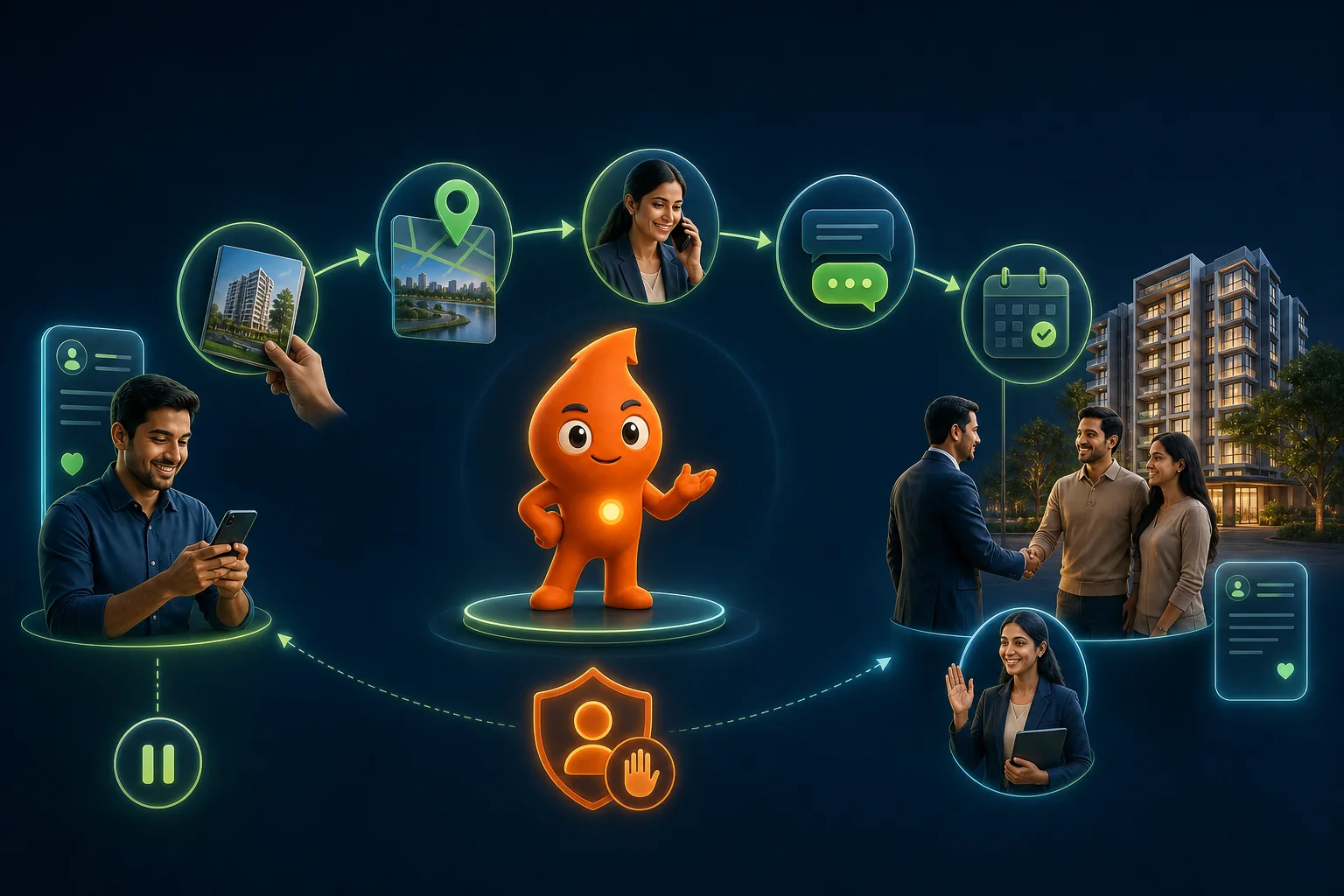
Short answer: Real estate lead follow-up should be fast at the start and then paced by the buyer's timeline: call within minutes, make 6–8 attempts across the first week, then switch leads who are not ready into a nurture track: weekly for buyers booking within 3 months, every two weeks for 3–6 months, and monthly for 6–12 months. Use calls for conversations, WhatsApp for documents and visit logistics, email for detailed material, and retargeting for reminders. Every message should carry a new, useful fact (price, construction progress, a loan update), and the sequence must stop on a reply, opt-out or booking.
How should you follow up a real estate lead in the first 7 days?
The first week decides whether you ever have a conversation. Response speed matters most: Harvard Business Review's study of online lead response found that most companies are not responding nearly fast enough, and in Indian property, where portal enquiries go to several sellers, the first relevant call usually wins. CRM vendor Sell.do says a lead called within a minute converts several times better than one called an hour later. This is the attempt pattern we use for a new enquiry that has not yet been reached:
| When | Channel | Action |
|---|---|---|
| 0–5 minutes | Call | First call, referencing the project and source |
| Immediately if unanswered | WhatsApp (utility template) | Send what they asked for (price sheet or brochure) and the advisor's name |
| +2 hours | Call | Second attempt |
| Day 1 evening (6–8 pm) | Call | Many salaried buyers answer only after work |
| Day 2 morning | Call + WhatsApp | Short message with one question: "Is 2 BHK or 3 BHK more useful to you?" |
| Day 3 | Email (if given) | Floor plans, location note, cost sheet |
| Day 5 (Saturday if possible) | Call | Weekend attempt; offer a site visit slot |
| Day 7 | Preference check: "Should I keep sending updates on [Project], or pause?" with buttons |
After about 7 attempts with no two-way contact, move the lead to "Unreachable" with a review date rather than calling every day. The lead management rules, SLAs and reassignment logic behind this table are in our real estate CRM and lead management guide.
How often should you follow up, by buyer timeline?
Once you have spoken to the buyer and recorded their timeline (see our qualification guide), the cadence follows that timeline, not your sales target. These are our starting defaults.
| Buyer timeline | Touch frequency | Main channels | Content focus | Goal |
|---|---|---|---|---|
| Booking within 30 days | Every 2–3 days, advisor-led | Call, WhatsApp | Unit availability, cost sheet, loan help, visit slots | Visit within 7 days, then booking |
| 1–3 months | Weekly | WhatsApp, call every 2 weeks | Comparisons, floor plans, location facts, offers if approved | Site visit |
| 3–6 months | Every 2 weeks | WhatsApp, email, retargeting | Construction progress, locality developments, home-loan explainer | Stay shortlisted; visit when ready |
| 6–12 months | Monthly | Email, WhatsApp, retargeting | Quarterly construction update, new tower or phase launch | Re-qualify each quarter |
| Investor | Every 2–3 weeks | WhatsApp, email | Rental demand data, infrastructure milestones with dated sources, payment plans | Call when a relevant release happens |
| NRI | Every 2 weeks, in their time zone | WhatsApp, email, video call | Video walkthroughs, NRI payment and documentation process, power of attorney steps | Video site visit, then family visit |
Re-ask the timeline every 4–6 weeks. A "6–12 months" buyer whose loan was just sanctioned is now a 30-day buyer, and the cadence should change the same day.
Which channels should you use, and what rules apply?
| Channel | Best for | Rules that apply | Cost |
|---|---|---|---|
| Phone call | Qualification, objections, visit booking | Calls about the buyer's own enquiry are part of serving that request; promotional calls must use registered 140-series numbers under TRAI's 2025 amendment; wait 90 days after an opt-out before asking for consent again | Calling plan / telephony |
| Documents, visit logistics, quick questions | Opt-in required by the Business Messaging Policy; outside the 24-hour window only approved templates | ₹0.115 per utility and ₹0.8631 per marketing message plus GST (rates from 1 October 2026) | |
| SMS | Visit reminders where WhatsApp is not used | Entity, header and template registration on DLT | Per-SMS from provider |
| Floor plans, cost sheets, monthly updates | Gmail's sender guidelines: SPF, DKIM and DMARC for bulk senders, one-click unsubscribe on marketing mail, spam rate below 0.3% | Low | |
| Retargeting ads | Keeping the project visible to site visitors | Platform audience policies; no personal details in creative | Media cost |
Category matters on WhatsApp. Meta's template guidelines define utility messages as non-promotional and specific to or requested by the user; anything persuasive is marketing and costs about 7.5 times more. A visit confirmation is utility; "new tower launched, book now" is marketing. Full rates are in our WhatsApp API cost guide, and consent rules in WhatsApp opt-in and template rules.
What should real estate nurture messages contain?
Each touch should give the buyer something they did not have before. A content bank that works for most projects:
- Cost clarity: all-in cost sheet for their configuration, with stamp duty and registration shown separately.
- Construction proof: dated photos or a 60-second video of the actual tower, monthly.
- Location facts: drive times to their office or school, with the date measured; infrastructure updates with an official source.
- Loan help: EMI for their budget at a stated rate, list of lenders that have approved the project.
- Comparison: an honest table versus the competing project they mentioned (carpet area, price per sq ft of carpet, possession date).
- Events: site open days, sample flat launch, customer meet.
Every claim about price, possession or amenities must match the project's RERA-registered details, because nurture messages are advertising too.
Which follow-up templates work for real estate leads?
Variables use Meta's {{1}} format. Category is shown because it decides both approval and price.
Brochure delivery after enquiry (utility)
Hi {{1}}, here is the price sheet and floor plans for {{2}} you asked for. I am {{3}}, your advisor. Which would help more next: a call to go through prices, or site visit timings? [Call me] [Visit timings]
No answer after two calls (utility)
Hi {{1}}, I tried calling about your enquiry for {{2}}. When is a good time for a 5-minute call? [Today evening] [Tomorrow morning] [Message me instead]
Monthly construction update (marketing)
Hi {{1}}, {{2}} update for {{3}}: Tower B slab work has reached the 14th floor. Photos taken on {{4}} are attached. Want me to share the latest availability for 3 BHK? [Yes, share] [Not now] [Stop updates]
Re-qualification at 6 weeks (marketing)
Hi {{1}}, you were looking at homes around {{2}} for {{3}}. Has anything changed in your plans? [Still looking] [Bought elsewhere] [Later this year] [Stop messages]
Email subject lines that get opened
- "Your 3 BHK cost sheet at [Project], with all charges"
- "[Project] construction: October photos"
- "EMI for ₹1.2 crore at today's rates"
Twenty-five more general follow-up templates are in our WhatsApp follow-up templates guide; the automated flows that send them are in WhatsApp automation for real estate.
How should you follow up after a site visit?
A completed visit is the most valuable moment in the funnel, and the one most often wasted by a generic "How was your visit?" message.
- Within 2 hours: WhatsApp recap with the units seen, cost sheet for the unit they liked, and the one question they asked that you promised to answer.
- Day 1: call to answer open questions and ask, "What would you need to decide?"
- Day 3: send the asset that addresses their main objection (see below).
- Day 7: offer a revisit with the family member who could not come, or a meeting with the loan partner.
- Day 14: if no movement, record the reason and move to the timeline cadence.
| Objection heard at visit | Follow-up asset |
|---|---|
| "Price is high" | Price per sq ft of carpet area vs the competitor they named; payment plan options |
| "Location is far" | Measured drive times at peak hours; dated infrastructure updates |
| "Worried about delays" | Developer's delivery record, current construction photos, RERA project page link |
| "Loan uncertain" | Lender list, EMI table, introduction to a loan advisor |
| "Parents need to see it" | Weekend revisit slot, pickup offer, video for those who cannot travel |
How do you reactivate old real estate leads?
Leads marked Nurture or Unreachable 3–12 months ago are your cheapest source of new visits. Once a quarter, filter them by project fit and send one clear message that names your business, gives a genuine reason (new phase, price revision, possession date, completed amenities) and offers an easy opt-out. Call only those who reply. Remove anyone who opted out or complained, and for people who opted out, wait at least the 90 days TRAI specifies before asking for consent again. If old leads cannot be used lawfully, do not replace them with bought lists; our leads database guide explains why.
When should follow-up stop?
- Immediately: on "stop", "not interested", a block, or a complaint, across every channel, in the CRM.
- Pause: when the buyer replies (a human takes over), books a visit (visit sequence takes over) or books a unit (post-sales takes over).
- Close as Lost: bought elsewhere (record the project), budget permanently out of range, or wrong number.
- Move to monthly: no reply to 3 consecutive nurture messages.
- Archive: no engagement for 12 months; review against your data retention rule.
What does a nurture programme cost, and how do you measure it?
Worked example: 1,000 leads in nurture, each receiving 12 marketing templates over six months, costs 12,000 × ₹0.8631 = ₹10,357 in WhatsApp fees, or about ₹12,221 with 18% GST. If that sequence brings back just 10 completed visits, the cost per visit is about ₹1,200 in message fees, far below the ₹5,000–60,000 per completed visit in the worked examples of our cost guide. Utility messages at ₹0.115 make confirmation and document delivery almost free.
| Metric | What it tells you |
|---|---|
| Reply rate per message | Which content earns attention |
| Opt-out and block rate | Frequency or relevance is wrong; investigate above 2% per send |
| Nurture-to-visit rate by timeline segment | Whether the cadence suits the segment |
| Days from enquiry to booking | Real cycle length for your project |
| Bookings from leads older than 90 days | The value of nurturing at all |
If you want the cadence built and run inside your CRM and WhatsApp, our WhatsApp CRM automation service does exactly that.
Sources
- Harvard Business Review: The Short Life of Online Sales Leads: slow lead response across companies.
- Sell.do: paid lead generation for real estate in India, 2026: speed-to-lead claim.
- Free Press Journal: WhatsApp rates in India from 1 October 2026: ₹0.8631 marketing, ₹0.115 utility and service.
- Meta: template category guidelines: utility vs marketing definitions.
- WhatsApp Business Messaging Policy: opt-in and opt-out.
- TRAI Press Release No. 11 of 2025: 140-series promotional calls, 90-day consent wait.
- Mobile Seva: SMS DLT registration: entity, header and template registration.
- Gmail email sender guidelines: authentication, one-click unsubscribe, spam-rate threshold.